
Detoxification: What It Really Means (and How to Support It Naturally)

“Detox” is one of the most commonly used—and misunderstood—terms in health and wellness. Juice cleanses, teas, and quick-fix programs promise to “flush toxins,” but from a naturopathic and functional medicine perspective, detoxification is not something you turn on for a week—it’s something your body is doing for you every single day.
In fact, your body already has highly sophisticated detoxification systems in place—no extreme cleanse required (NCCIH).
Understanding how this process works—and how to support it—can improve energy, hormone balance, skin health, and overall resilience.
Your Body Already Has a Detox System
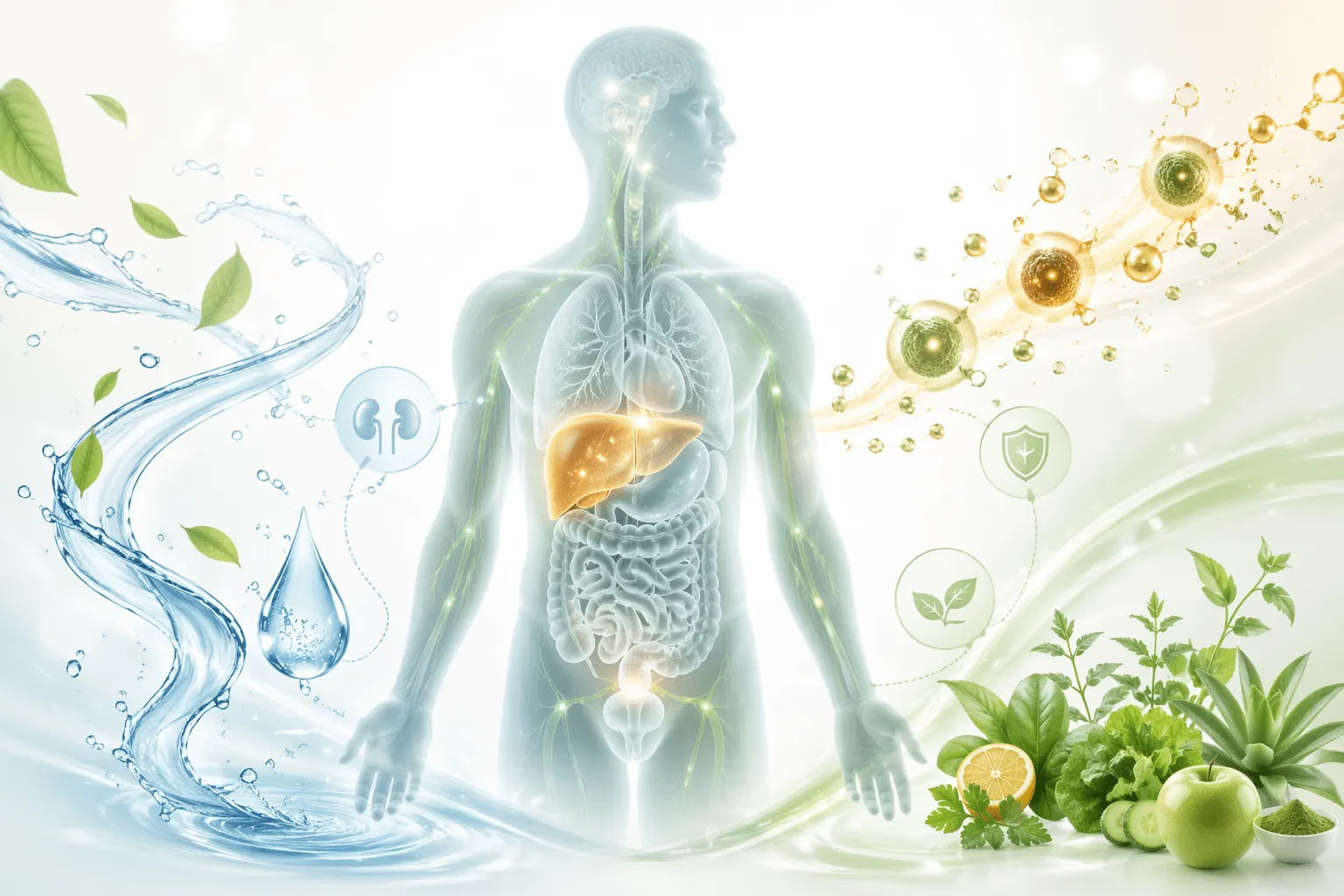
Your body is incredibly intelligent. Detoxification is a built-in, continuous process primarily carried out by the liver, but also supported by the gut, kidneys, skin, and lymphatic system.
Think of your body like a highly efficient water filtration system. Every day, it filters and processes:
- Environmental chemicals (pollution, pesticides, plastics)
- Medications and alcohol
- Hormones (like estrogen after it’s used)
- Natural metabolic waste
The goal? Convert these substances into forms that can be safely eliminated through urine, stool, sweat, and breath—a process well-described in environmental medicine research (Sears & Genuis, 2012).
The 3 Phases of Detoxification (Simplified)
Detoxification happens in three coordinated steps:
- Phase 1: Breaks toxins down (like dismantling furniture before moving it)
- Phase 2: Packages them safely (like boxing those pieces securely using specialized enzymes)
- Phase 3: Eliminates them (taking the boxes out to the curb)
Phase 2 detoxification, in particular, relies heavily on specific enzymes and nutrients to neutralize potentially harmful intermediates (Jancova et al., 2010).
If any step is under-supported, the system can feel backed up.
A Naturopathic Approach to Supporting Detox
Instead of forcing detox, we focus on supporting the body’s natural pathways—like making sure all parts of that filtration system are working smoothly.
1. Nourish the Liver (Give It the Right Tools)
Your liver is like a busy processing plant—it can only do its job well if it has the raw materials it needs.
Foods rich in specific nutrients help both Phase 1 and Phase 2 detox pathways run efficiently:
- Cruciferous vegetables (broccoli, kale, Brussels sprouts) help activate detox enzymes and support healthy metabolism (Higdon et al., 2007)
- Garlic and onions provide sulfur compounds that support detox pathways
- Colorful fruits and vegetables supply antioxidants that protect the liver during processing
Without these nutrients, detox can become inefficient—like trying to run a factory with missing parts.
2. Support Antioxidants (Contain the “Sparks”)
Detoxification isn’t a perfectly clean process. When your body breaks down toxins, it temporarily creates reactive compounds—think of these like sparks flying during metalwork.
Antioxidants are your internal fire extinguishers. Nutrients like:
- Vitamin C
- Vitamin E
- Glutathione
help neutralize these “sparks” and protect your cells from oxidative stress (Forman et al., 2009).
Without enough antioxidant support, you may feel symptoms like fatigue, headaches, or brain fog—especially during more intensive detox efforts.
3. Optimize Elimination (Take the Trash Out Daily)
Processing toxins is only half the job—you also have to eliminate them.
Think of this like taking out the trash. If it sits in your kitchen too long, it starts to smell—and eventually affects the whole house.
Key elimination pathways include:
- Bowel movements (primary route via bile)
- Urination
- Sweating
Efficient elimination is essential to prevent reabsorption of toxins (Sears & Genuis, 2012).
Simple ways to support this:
- Fiber-rich foods
- Adequate hydration
- Regular movement
4. Reduce Incoming Toxins (Turn Down the Faucet)
Supporting detox isn’t just about improving output—it’s also about reducing input.
You can think of your body like a sink:
- Detox pathways = the drain
- Toxin exposure = the faucet
If the faucet is running full blast, even the best drain will struggle to keep up.
Health organizations emphasize that reducing exposure to environmental toxins is a key part of supporting overall health—not just detox programs (NCCIH).
5. Prioritize Lifestyle Foundations (Support the Whole System)
Detox isn’t just about food—it’s a full-body process influenced by how you live day-to-day.
Think of sleep, movement, and stress as the “operating system” your detox pathways run on.
- Sleep: Your body performs critical repair and metabolic processing overnight
- Movement: Helps circulate blood and lymph, supporting toxin transport
- Stress management: Chronic stress can impair detox pathways and increase overall burden
Even the best nutrition plan can fall short if these foundations aren’t in place.
The Bottom Line
Detoxification is not a trend—it’s a fundamental function of your body.
You don’t need extreme cleanses—you need to support the systems already built into your biology.
When those systems are nourished and balanced, your body does what it’s designed to do—efficiently and effectively.
Ready to Support Your Detox Pathways?
If you’re experiencing:
- Fatigue or brain fog
- Hormone imbalances
- Skin issues
- Digestive concerns
- Sensitivity to foods, chemicals, or medications
…it may be a sign your detox pathways need support.
At our clinic, we take a personalized, root-cause approach—looking at your nutrition, lifestyle, environment, and labs to understand how your body processes and eliminates toxins.
Your next step:
Schedule a visit to assess your detox capacity and get a customized plan tailored to your body—not a one-size-fits-all cleanse.
Because true detoxification isn’t about doing more—it’s about supporting your body to work better.
References
- National Institutes of Health, National Center for Complementary and Integrative Health (NCCIH).
“Detoxes” and “Cleanses”: What You Need to Know.
https://www.nccih.nih.gov/health/detoxes-and-cleanses-what-you-need-to-know - Sears ME, Genuis SJ.
Environmental determinants of chronic disease and approaches to detoxification.
Journal of Environmental and Public Health. 2012;2012:356798. - Jancova P, Anzenbacher P, Anzenbacherova E.
Phase II drug metabolizing enzymes.
Biomedical Papers. 2010;154(2):103–116. - Forman HJ, Zhang H, Rinna A.
Glutathione: Overview of its protective roles and biosynthesis.
Molecular Aspects of Medicine. 2009;30(1-2):1–12. - Higdon JV, Delage B, Williams DE, Dashwood RH.
Cruciferous vegetables and cancer risk: mechanistic insights.
Pharmacological Research. 2007;55(3):224–236.
You may also enjoy
 Detoxification
Oct 6, 2026
Why Detoxification Is the Missing Piece in Hormone Balance
When women come to see me struggling with perimenopause, the conversation almost always starts with hormones. But after three decades of practice, I have learned that hormone therapy alone is rarely the whole story. If detoxification pathways are overwhelmed, even well-dosed bioidentical hormones are fighting an uphill battle.
 Regenerative Medicine
Jan 22, 2026
Therapeutic Plasma Exchange (TPE) for Longevity: Benefits, Safety, and Anti-Aging Science
Aging gracefully isn’t just about looking younger, it’s about feeling energetic, maintaining cognitive clarity, and supporting your body’s resilience. While lifestyle factors like nutrition, exercise, and sleep are foundational, science is increasingly focusing on blood-based interventions to support healthy aging and longevity. One emerging therapy gaining attention is Therapeutic Plasma Exchange (TPE), also known as…
 Regenerative Medicine
Jan 12, 2026
Feeling Blue? I’ve Got Good News for You, Methylene Blue!
Methylene blue is far more than a medical dye. Emerging research highlights its role in supporting cellular and mitochondrial health, with growing scientific interest in its potential in longevity and integrative medicine. History behind Methylene Blue Methylene blue has been around for a very long time.…